THE CALL STANDARD™ - HOW I GRADE A SOFA
Most furniture shopping asks the wrong question.
It asks whether the sofa is pretty. Whether the color works. Whether the shape feels current. Whether the room in the photograph looks like a better version of the life the shopper already has.
Those things matter, but they do not matter first. A sofa is not a decorative thought. It is a working object. It holds bodies, absorbs wear, takes stains, collapses slowly or does not, fits a room well or badly, and either earns its price over time or becomes another expensive object no one wants to admit was a mistake.
The Call Standard exists because retail furniture is sold through feeling, but owned through use.
It is a way to judge furniture in public using the kind of questions designers already use privately. Not taste alone. Not price alone. Not brand reputation. Not a showroom sit that lasts ninety seconds under flattering light. The standard looks at what the piece is, what it costs, how much the seller tells us, and whether the construction supports the promise.
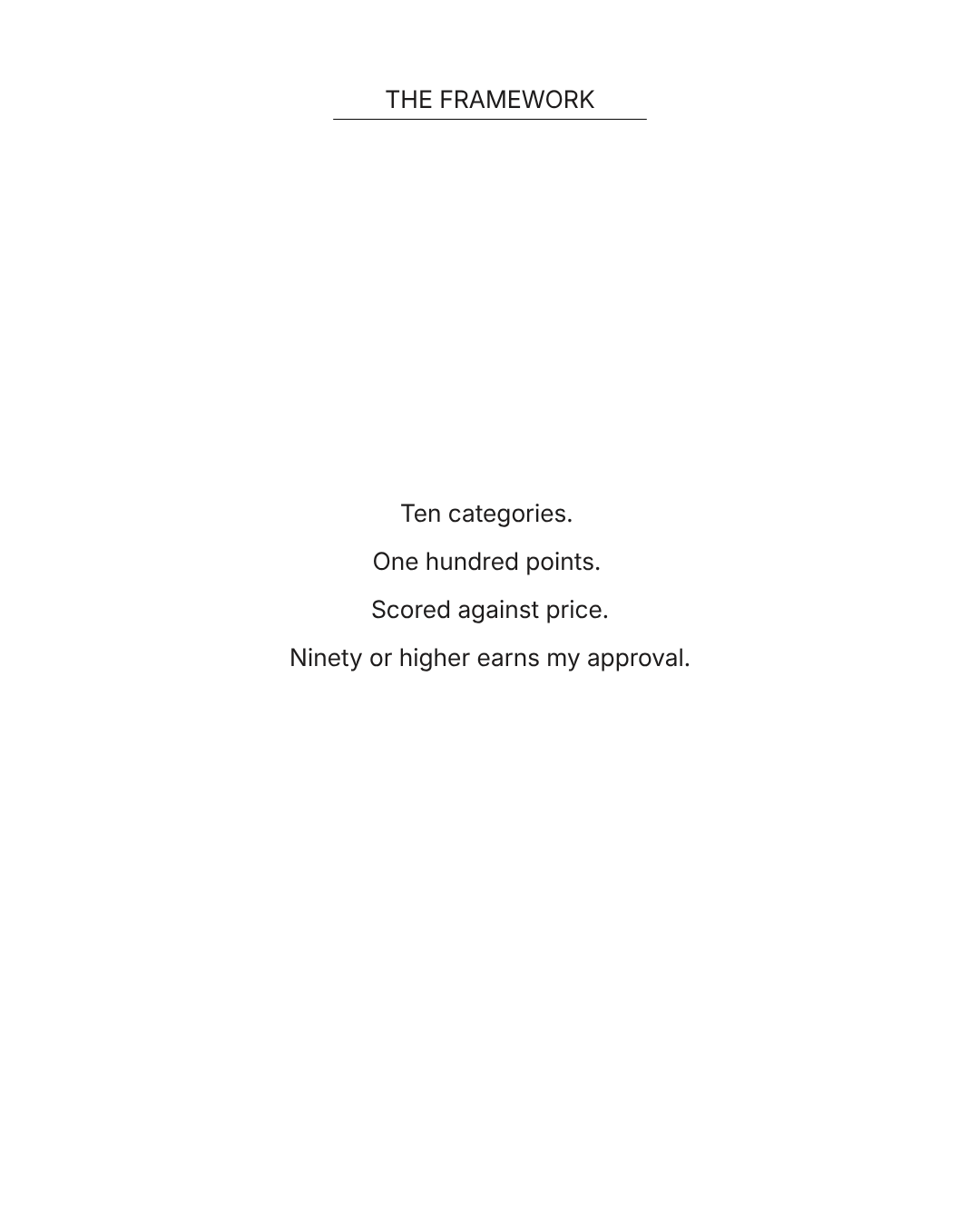
Ten categories. One hundred points. Scored against price.
That is the framework.
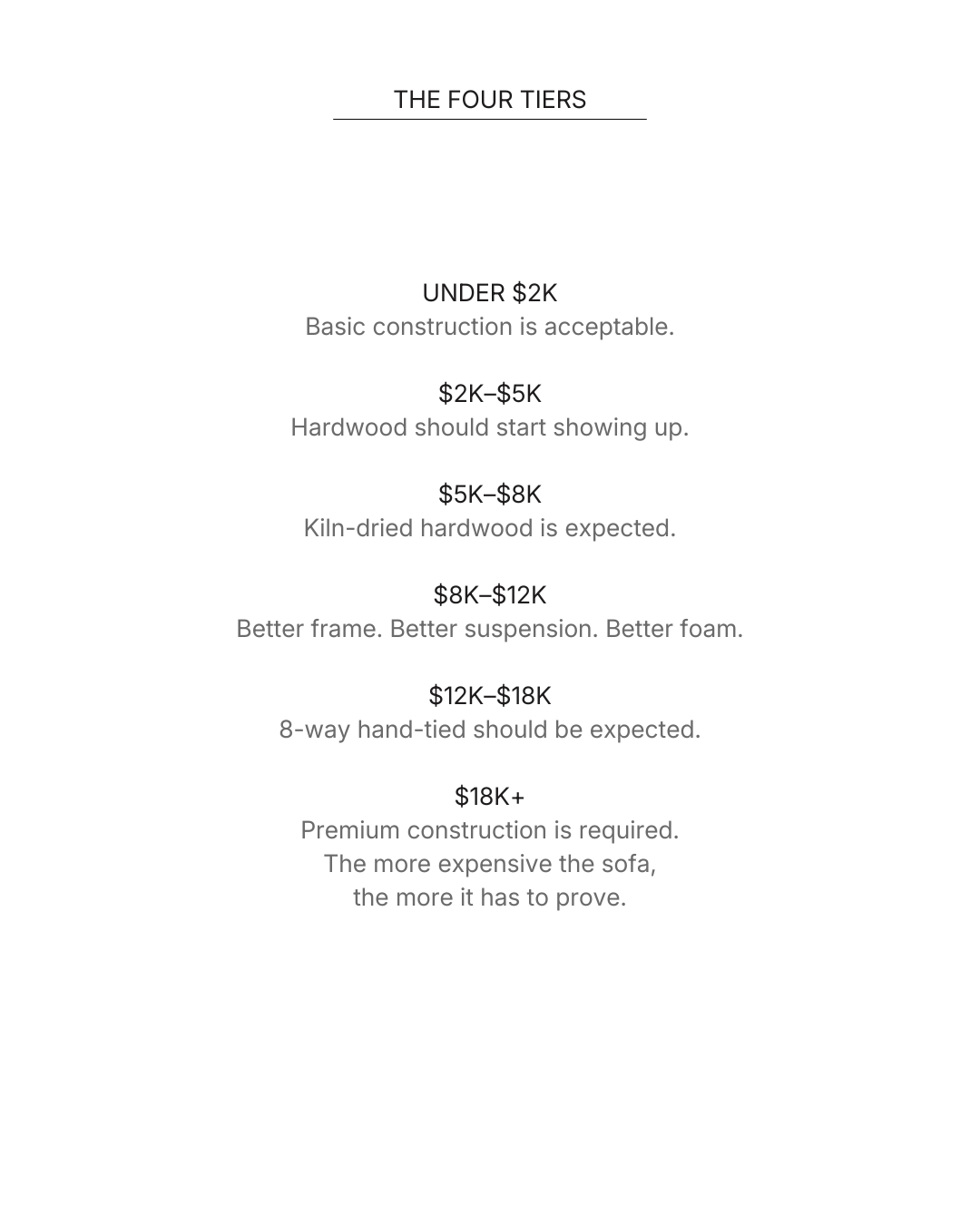
A sofa under $2,000 is not judged as if it were a $12,000 sofa. That would be ridiculous and mostly a way to feel superior while being useless. Entry-level furniture has different expectations. Engineered wood may be acceptable. Sinuous springs may be fine. A 1.8 lb foam can pass if the price is honest and the rest of the product behaves.
At $2,000 to $5,000, the expectations change. Hardwood should begin to appear. Sinuous or coil springs should be disclosed. Foam should become more serious. The shopper is paying enough that the product should start explaining itself.
At $5,000 to $8,000, the money needs to show up in the bones. Kiln-dried hardwood becomes expected. The suspension matters more. Cushion fill needs to be clearer. A sofa at this price cannot coast on a nice arm and a room photograph with a bowl of pears.
At $8,000 to $12,000, the excuses get thinner. Better frame. Better suspension. Better foam. Better disclosure. The price has left the territory of casual optimism. The object should know what it is made of and be willing to say it out loud.
At $12,000 to $18,000, the standard gets harder. Eight-way hand-tied suspension should be expected unless the maker can explain a better reason. Foam, down, fill, frame, fabric, and warranty should all be clear. Missing information at this price is not a charming mystery. It is a problem.
At $18,000 and above, the sofa has to prove why it exists at that price. It should not merely be expensive. It should be exceptional, specific, well-built, well-explained, and difficult to confuse with something less serious. If a sofa costs that much and still hides its construction, the silence becomes part of the review.
That is the point of price-tier scoring. The standard changes by price. The score stays honest.
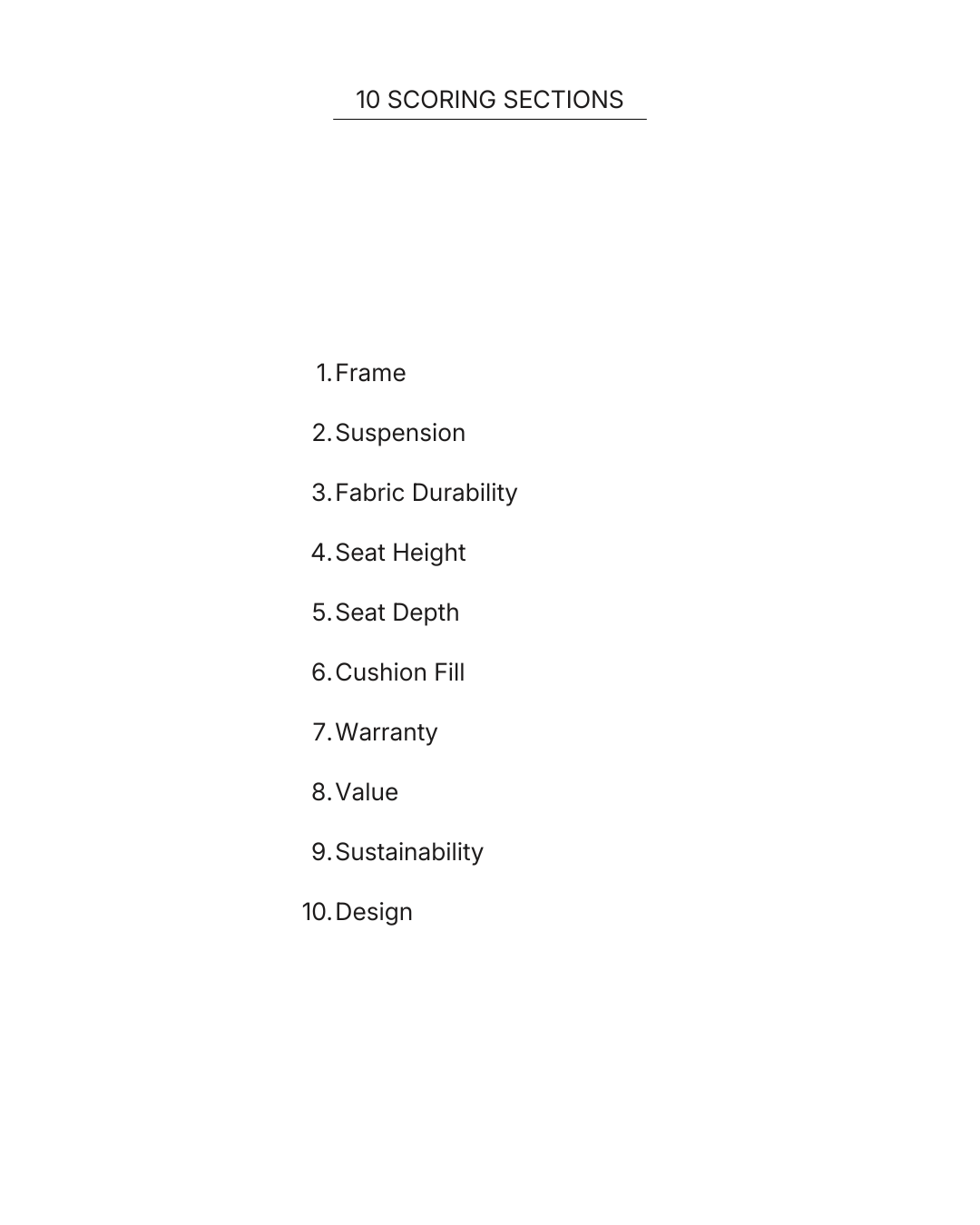
The ten categories are simple because the shopper needs the system to be usable. Frame. Suspension. Fabric durability. Seat height. Seat depth. Cushion fill. Warranty. Value. Sustainability. Design.
Frame asks what the body is made of. A sofa is not only the part you see. The frame determines whether the piece holds its shape, survives movement, and resists the slow loosening that makes furniture feel tired before it looks old. Hardwood, kiln-dried hardwood, engineered wood, plywood, joinery, corner blocks, disclosure: these are not romantic details. They are the skeleton.
Suspension asks what supports the sitter. Sinuous springs, webbing, coils, eight-way hand-tied construction, and proprietary systems do not behave the same way. Some are perfectly fair at the right price. Some are shortcuts. Some are excellent. Some are just words on a product page trying to pass for engineering.
Fabric durability asks whether the surface can survive the room. Double rubs matter. Fiber content matters. Cleaning code matters. Stain resistance matters. A sofa is only as durable as the fabric the shopper actually orders. A strong frame under a fragile fabric is still a fragile purchase.
Seat height asks whether people can sit down and get up without negotiating with the furniture. Too low can feel severe in a photograph and irritating in daily life. Too high can feel stiff. The correct height depends on the use, but the number matters.
Seat depth asks what kind of sitting the sofa is built for. Cocktail depth is for upright sitting. Classic depth gives the middle ground. Lounge depth is for stretching out. A deep sofa is not automatically comfortable. Sometimes it is just a bed that learned upholstery.
Cushion fill asks what happens after the first sit. This is where many sofas reveal themselves. Foam density, down blend, fiber wrap, spring core, recovery, crown, and edge behavior all matter. A cushion that feels soft in the store may require constant fluffing at home. That is not comfort. That is unpaid labor.
Warranty asks whether the maker stands behind the product. Warranty is not the whole story, but it is a useful signal. A short, vague, or heavily excluded warranty tells the shopper something. So does a clear one.
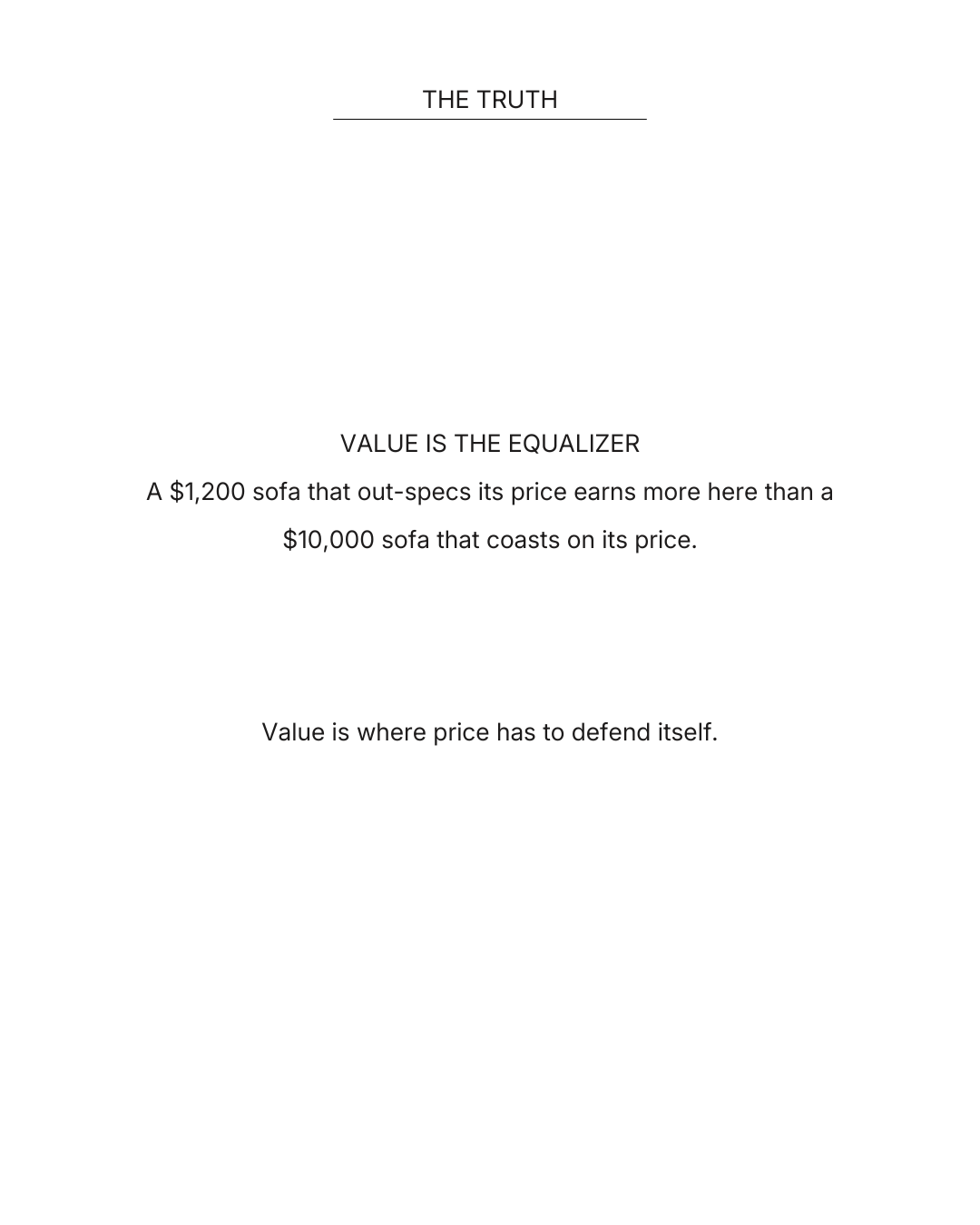
Value asks whether the price can defend itself. This is the equalizer. A $1,200 sofa that out-specs its price earns more here than a $10,000 sofa that coasts on its price. Value is not cheapness. Value is the relationship between cost, construction, disclosure, design, and expected life.
Sustainability asks for proof, not mood. Longer life is sustainable. Repairability matters. Better materials matter. Certifications can matter. Vague green language does not. A sofa that falls apart quickly is not made better because the product copy found a leaf.
Design asks whether the piece is good as an object in a room. Proportion. Line. Scale. Posture. Arm shape. Back view. Cushion structure. Edge detail. The sofa has to look right, but design is not decoration alone. Good design supports use. Bad design hides weakness with shape.
The Call Standard is not a personality test for furniture. It is a pressure test.
The Call Standard also does something retail does not always want done. It treats unknown information as information.
Unknown does not always mean failure. Most mainstream retailers do not publish everything a designer would want to see. Missing foam density at an entry price is a note, not a death sentence. Missing double rubs at a lower price may cap confidence without killing the sofa. The standard is not designed to punish normal shoppers for shopping normal stores.
But unknown is not confidence.
The higher the price, the less patience there is for missing information. A $1,600 sofa can have some gaps if the whole product is honest for the money. A $16,000 sofa cannot behave like the frame, suspension, foam, and fabric are private matters. At that level, opacity is not a quirk. It is part of the verdict.
This is where the standard becomes useful. It does not ask, “Is this sofa good?” in the abstract. It asks, “Is this sofa good for its price, with the information available, for the way it is likely to live?”
A modest sofa can score well because it does its job honestly. An expensive sofa can score poorly because it refuses to prove the thing it is charging for. Price does not buy approval. Brand reputation does not buy approval. A handsome photograph does not buy approval. The piece has to earn it.
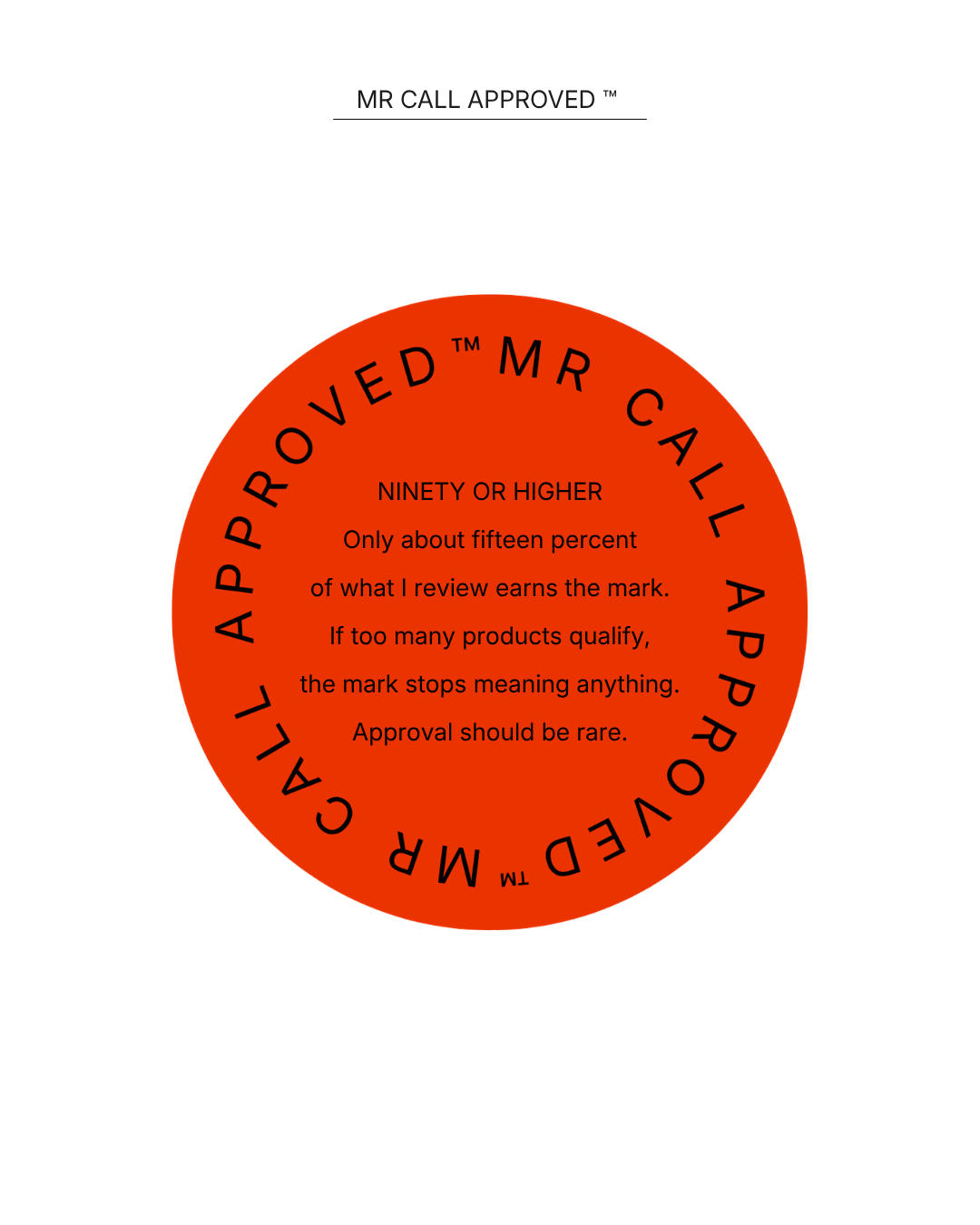
Ninety or higher earns Mr Call approval. That mark is intentionally rare. If too many products qualify, the mark stops meaning anything. Approval should not be a participation ribbon for furniture with decent lighting. It should mean the object passed the standard at its price and gave enough proof to deserve public confidence.
Most reviewed products will not earn the mark. That is not a problem. A sofa can still be recommended below ninety. It can be good, useful, and worth buying without becoming exceptional. Some pieces will be recommended with reservations. Some will not be recommended at all. They may still publish. The conclusion is the service.
The point is not to make shopping colder. The point is to make it less vague.
Retail furniture has trained shoppers to look first and ask later. The Call Standard reverses that. It asks what the piece is made of. How it sits. What it hides. What it proves. What the price demands. What will happen after the room stops being new.
A sofa is not finished when it looks good online. It is not finished when it arrives. It is not even finished when it feels good the first week.
The real test begins when the fabric takes life, the cushion takes weight, the frame takes movement, and the price has to justify itself without the photograph.
That is where The Call Standard works.
It makes the private logic public. It gives the shopper the questions before the mistake. It turns furniture from a mood into a judgment.
The object must earn the space it occupies.