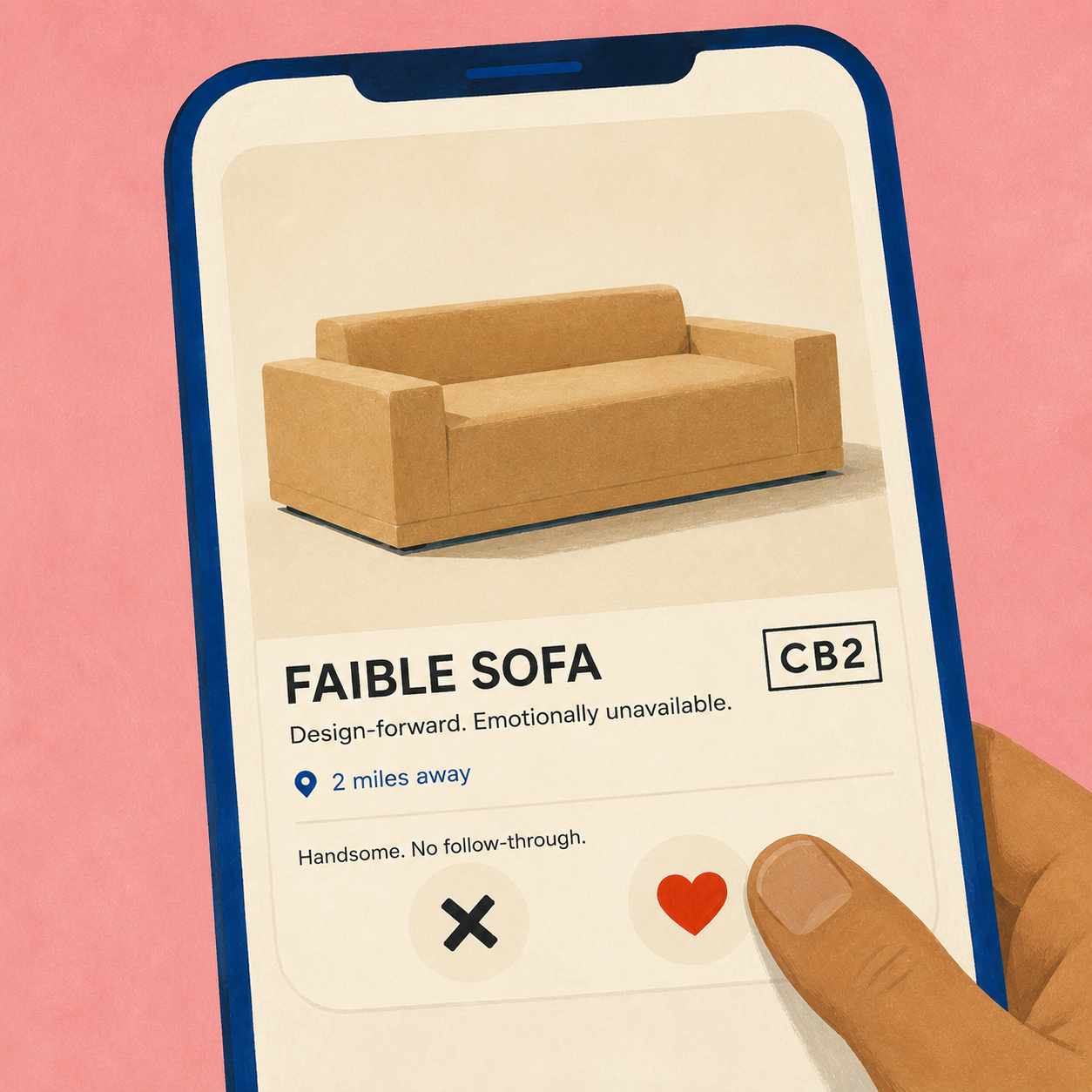
CB2: FAIBLE
Chapter One: The Profile
In my middle-aged married life, I no longer use Tinder. I browse the CB2, West Elm, and Crate & Barrel apps to see if I match.
I swipe. I save. I read the bio. Performance velvet. Pocket coil. Bench seat. I check the height, the depth, the reviews. I look at the photos longer than I should — the way I used to look at men’s photos longer than I should — trying to decide if the lighting was generous or if he really did look like that on a Sunday.
Most of the time it ends there. A screenshot. A pin. A maybe. All very innocent.
But once in a while, against my better judgment, I set a date.
This Tuesday, it was the Faible. CB2 in West Hollywood. Across from the Chateau Marmont and next to the Trader Joe’s. You know the intersection. We have all made bad decisions there.
Christian dropped me in the alley behind the store.
“Make it quick,” he said.
He is German-Brazilian, which means time is sacred and every errand is either efficient or a moral collapse. He had agreed to this reluctantly, the way one agrees to most of the things one’s husband insists on after already explaining, slowly, why they are unnecessary.
I had thirty minutes. Forty if I bought him coffee on the way back. Forty-five if the coffee had foam art.
I got out of the car. I looked up. And there he was, in the window, The Faible.
“Hello, beautiful,” I said.
Out loud. To the window.

Chapter Two: The Date
I had dressed for the occasion. I do this. I am a designer. I cannot help myself. The editorial photo of the Faible was already on my phone — cream bouclé, golden hour, a martini somewhere just out of frame — and I had coordinated my outfit to match him. Linen trousers. A pale Jacquemus shirt, fashionably cropped, the kind that looks French in a mirror and ambitious anywhere else.
If Christian texted to check on the date, I could send a selfie from the sofa. Cream on cream. A man and his match.
That was the plan.
Inside, I drifted. I admired a bamboo lantern I would hate by Thursday. I touched a travertine side table with the solemnity of someone pretending not to check a price tag. I let myself believe.
The Faible held his line. He was tall, but not in an annoying way. Confident, but not the kind of confident that needs you to know. Soft around the edges. He looked like someone who would let me pick the restaurant and then actually be glad about it. He looked like he had a therapist and used him.
I let myself imagine the rest of my life with him.
And then he invited me to sit.
Me? I looked around. Did anyone else see that this sofa had just asked me to sit?
Chapter Three: The Descent
I do not sit at home the way I was about to sit here. At home I sit with velocity. Sandra Bullock in Gravity. Full surrender. That is not first-date energy.
So I side-saddled. Feet together. Tote held like a clutch. Right hand grazing the cushion the way a woman in a Sargent painting grazes a chair. Eyes locked on the far wall.
I lowered.
Slowly. Controlled.
My thighs began to burn. Note to self: re-up the spin class. The one that has been auto-billing since March.
I lowered some more.
A veil of sweat. The tote arm trembling. My right hand now searching, the way a hand searches for the bottom step in the dark.
Am I ever going to land.
I AM IN FREE FALL.
The cushion broke my fall and rotated me. The Sargent hand abandoned grace and grabbed the back of the sofa. My knees came up past my eyeline. The seat was absorbing me. Quicksand. No support.
What had started as a date had become a hostage situation.
And this is where the Jacquemus turned on me.
JACQUEMUS, NOOOOOOO.
A fashionably cropped shirt is engineered to flatter a vertical body. A sixteen-inch seat does not produce a vertical body. It produces a folded body. The shirt, faithful to its design, rode up. My belly — patient, middle-aged, the soft documentary of television and contractors and the long defeat of my thirties — emerged into the West Hollywood afternoon like a guest no one had invited.
Chapter Four: The Witness
The clerk appeared at the edge of my vignette. He had the calm of a man who works on commission and the eyes of a man who had seen this before.
“Do you need any help?” he said.
I considered the question. Medical. Psychological. Romantic. Spiritual. Logistical. Commercial. The full menu.
I gave him a thumbs up from somewhere inside the Faible, because I am polite and was raised correctly. What I really needed was a winch, an emergency exit, and a non-disclosure agreement.
He drifted away. The Faible held me there a moment longer, the way bad dates do, just to make sure I knew who was in charge.
And somewhere between my exposed midriff and my missing lumbar support, I had to ask myself: when did comfort become the thing we were willing to give up for a good profile?
Strip away the bouclé, the brass legs, the catalogue lighting. Strip away the aspirational woman in the product photo who has never watched television sideways.
A sofa has three jobs.
Design. Value. Comfort.
That is the sacred triangle. The domestic throuple. And somehow, in the modern furniture economy, asking for all three at once feels vulgar.
Chapter Five: The Domestic Throuple
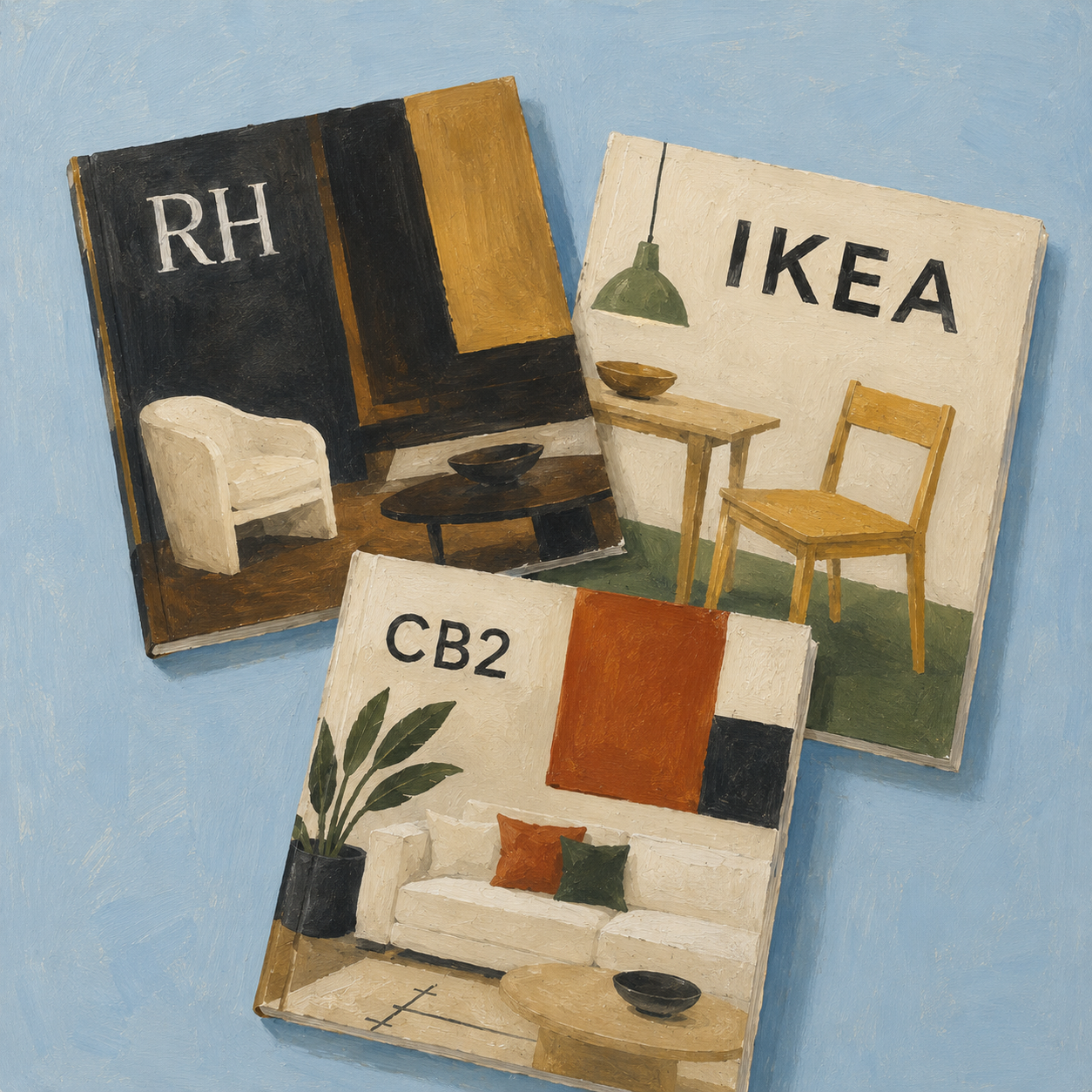
Restoration Hardware saw the problem and chose money. Its sofas are deep, handsome, and lit like minor European royalty. You sink into one and understand, briefly, why people make terrible decisions in hotel bars. RH gives you design and comfort, then quietly asks whether you have considered selling a kidney.
IKEA saw the problem and chose humility. It gives you value and comfort, but first makes you prove devotion with a hex key and a marriage test. The sofa may be perfectly fine, but the relationship begins in a warehouse and ends with one person saying, “No, the other left.”
CB2 saw the problem and chose the photograph. It understands the apartment. It understands the crop. It understands the part of you that wants to look interesting without becoming responsible for an actual antique. CB2 gives you design and value, then removes your spine like a service.
Three stores. Three promises. Three compromises in good lighting.
The romantic in me wanted to believe the Faible could be different. The designer in me appreciated the line. The middle-aged man in a cropped Jacquemus shirt wanted to stand up without needing witnesses.
This, I suppose, is the real danger of the showroom. It sells you the hanger, not the movement. The profile, not the Sunday. The photograph, not the body that has to live inside it.
Is a sofa like a vintage Chanel suit? Timeless on the hanger, devastating in the mirror, and quietly impossible the second you try to breathe?
Or is it more like a man on an app: beautifully upholstered, correctly lit, and hiding a structural flaw just below the cushion?
Chapter Six: The Exit
The clerk drifted back. He did not ask again. He just nodded, which was kinder.
I stood up. It took two tries and a small private decision to live. I dusted myself off. I pulled the Jacquemus back down to its intended latitude. I asked where the bathroom was.
He pointed across the rotunda, to the Trader Joe’s.
Of course.
I walked out of CB2 and into the next storefront. Bells rang. Hawaiian shirts. Single bananas in a bin. The peculiar fluorescent calm of a grocery store that has always known exactly who it is. It left me questioning who I was.
I made my way past the seasonal display and the man handing out tiny cups of cold brew. He offered me one. I declined. Caffeine could not fix what the Faible had broken.
Something told me I was not the first person to do this walk after a sofa date.
Cold water on the face. A look in the mirror. I did not love what I saw — a man who had dressed cream-on-cream for a sofa, who had used the word match, who had let himself imagine the rest of his life with a piece of upholstery he had known for fourteen seconds.
I pulled the phone out of my tote and called Christian.
“Hey baby. I’m all done. Come and get me.”
A pause.
“How was he?”
I glanced in the mirror. The shirt was back in place. The body had survived. The optimism was dented, but medically present.
“Handsome,” I said. “No follow-through.”
“I’m in the alley,” he said.
He had not driven anywhere.
He had known.
Outside, West Hollywood had resumed itself. The Chateau across the street. The Trader Joe’s bells behind me. Christian idling in the alley with the patience of a man who had predicted the entire plot.
The Faible was not the one. Beautiful, yes. Photogenic, certainly. But love cannot be built on a sixteen-inch seat and a lie.
Still, somewhere out there, I believe he exists. Tall enough to seat me. Soft enough to hold me. Sensible enough that Christian will not make the invoice face.
I have not met him yet.
But I am still swiping.
To be continued…
STILL SWIPING is the ongoing story of a married luxury interior designer power-dating retail furniture with dangerous optimism, occasional public humiliation, and the stubborn belief that one useful thing can be learned before next week’s date.